
NYIOOC World Olive Oil Competition — The Ultimate Guide
NYIOOC olive oil competition results are the single most reliable indicator of olive oil quality in the world today. When the New York International Olive Oil Competition publishes its annual results, producers, retailers, and educated consumers pay close attention — because these results separate genuinely premium oils from the flood of misleading labels on supermarket shelves. If you have ever wondered whether a bottle truly deserves its “extra virgin” claim or its premium price tag, NYIOOC olive oil competition results give you the definitive, unbiased answer.
In this ultimate guide, we break down everything you need to know: how the competition works, what Gold and Silver awards actually signify, why the Chetoui cultivar’s record of 82 awards (46 Gold, 36 Silver) is extraordinary, and how you can use these results to buy better olive oil in Malaysia and beyond.
Table of Contents
- What Is the NYIOOC World Olive Oil Competition?
- How the NYIOOC Judges Olive Oil Quality
- Understanding NYIOOC Olive Oil Competition Results: Gold vs Silver vs No Award
- The Chetoui Record: 82 NYIOOC Awards Olive Oil Producers Dream About
- Why NYIOOC Olive Oil Competition Results Matter More Than Marketing Claims
- The Lab Numbers Behind the Awards: Chemical Proof of Quality
- How to Use NYIOOC Results When Buying Olive Oil
- Other Olive Oil Competitions Worth Knowing
- What Separates Olive Oil Competition Winners from the Rest
- Frequently Asked Questions About NYIOOC Olive Oil Competition Results
What Is the NYIOOC World Olive Oil Competition?
The New York International Olive Oil Competition (NYIOOC) has been running since 2013 and has rapidly grown into the world’s largest, most prestigious, and most closely watched olive oil quality competition. It is organized annually in New York City and draws entries from every major olive oil producing nation on the planet.
Here are the essential facts that make the NYIOOC the gold standard of olive oil evaluation:
- Scale: The competition receives entries from over 28 countries and more than 1,000 brands every year, making it the most comprehensive global survey of olive oil quality available.
- Selectivity: Only approximately 30% of entries receive any award. This is emphatically not a participation-trophy competition — the majority of entrants go home empty-handed.
- Independence: The NYIOOC operates completely independently from olive oil producers, distributors, trade associations, and government bodies. There is no pay-to-win mechanism.
- Judging panel: An international team of certified olive oil sensory assessors, each rigorously trained in the International Olive Council (IOC) methodology.
- Blind tasting: Every sample is coded before reaching judges. They never know the brand, origin, cultivar, or price of what they are evaluating. The oil speaks entirely for itself.
- Transparency: All results are published publicly on the official Guide to the World’s Best Olive Oils at bestoliveoils.org, making them fully transparent and verifiable by anyone.
This combination of scale, independence, blind methodology, and public transparency is why NYIOOC olive oil competition results carry more weight than any other quality indicator in the industry. When a brand claims quality, these results tell you whether the claim holds up under expert scrutiny.
How the NYIOOC Judges Olive Oil Quality
Understanding how the NYIOOC judging process works helps you appreciate what an award actually represents. The judging follows the IOC sensory analysis protocol, which is the internationally recognized standard for olive oil evaluation. Judges assess each oil across three core positive attributes, check for defects, and evaluate overall harmony.
1. Fruitiness — The Foundation of Quality
The panel first assesses the olive fruit character present in the oil. This can manifest as green fruitiness (from early harvest olives, characterised by notes of fresh grass, artichoke, green tomato, and herbs) or ripe fruitiness (from mature olives, characterised by softer, rounder notes). Green fruitiness typically correlates strongly with higher polyphenol content and scores exceptionally well in competition. This is the fresh, vegetal, distinctly “green” character that defines premium extra virgin olive oil.
2. Bitterness — The Misunderstood Positive
Contrary to what many consumers assume, bitterness is a positive attribute in professional olive oil evaluation. It indicates the presence of polyphenols — specifically oleuropein and its derivatives. In competition judging, higher bitterness correlates directly with higher polyphenol content, which means better quality. An oil with no bitterness would actually score poorly in professional assessment. This is one reason why Chetoui olive oil from Tunisia performs so well — its naturally intense bitterness is exactly what judges reward.
3. Pungency — The Oleocanthal Signature
Pungency is the peppery, throat-catching sensation caused by oleocanthal, the powerful anti-inflammatory compound found in high-quality olive oil. Judges assess both its intensity and its quality — clean, sharp pungency indicates high oleocanthal content and freshly made, well-processed oil. This is the “cough test” that consumers can try at home, but competition judges quantify it precisely on a calibrated sensory scale developed by the IOC.
4. Defect Assessment — Zero Tolerance
Beyond positive attributes, judges systematically check for sensory defects. These include rancidity (oxidation), fustiness (fermented olives from improper storage), mustiness, winey or vinegary notes, metallic tastes, and frozen or heated defects. Any detectable defect immediately disqualifies an oil from extra virgin classification and from receiving any competition award. The standard is absolute zero defects — there is no margin of tolerance. You can learn more about how to identify genuine versus fake olive oil using some of these same defect markers.
5. Harmony — What Separates Gold from Silver
Finally, judges evaluate the overall balance and complexity of the oil — how well the fruitiness, bitterness, and pungency integrate into a unified sensory experience. The best olive oil competition winners demonstrate not just intensity across all three positive attributes, but also a sophisticated interplay between them. An oil that is explosively bitter but has no corresponding fruitiness would lack harmony. This assessment of balance and complexity is the primary factor that separates Gold award oils from Silver award oils.
Understanding NYIOOC Olive Oil Competition Results: Gold vs Silver vs No Award
Now that you understand how the judging works, let us examine what each award tier actually means for you as a consumer. When you look at NYIOOC olive oil competition results, each category tells a specific story about quality.
Gold Award — World-Class Excellence
A Gold award at the NYIOOC means the oil demonstrated exceptional quality across every criterion — intense positive attributes (fruitiness, bitterness, pungency), absolute zero defects, and outstanding harmony and complexity. Fewer than 15-20% of all entries typically receive Gold in any given year. A Gold-awarded oil is world-class by any objective measure. When you buy a Gold-winning oil, you are buying an oil that trained international experts agreed represents the pinnacle of olive oil quality.
Silver Award — Excellent Quality Confirmed
A Silver award indicates excellent quality with strong, clearly expressed positive attributes and no detectable defects. The oil may have slightly less complexity, intensity, or harmony than Gold winners, but it is still significantly above the quality level of average commercial olive oil. Silver-awarded oils represent approximately 10-15% of entries and are genuinely premium products by any standard.
No Award — The Majority
Approximately 70% of entries at the NYIOOC receive no award at all. This does not automatically mean the oil is bad or defective — it may simply not have reached the intensity, complexity, and balance thresholds that competition-level judging demands. However, it does mean the oil could not distinguish itself among a field of premium entries submitted by producers who believed their oil was competition-worthy. This is an important reality check for the many brands that claim “premium” status without competition validation.
The Chetoui Record: 82 NYIOOC Awards Olive Oil Producers Dream About
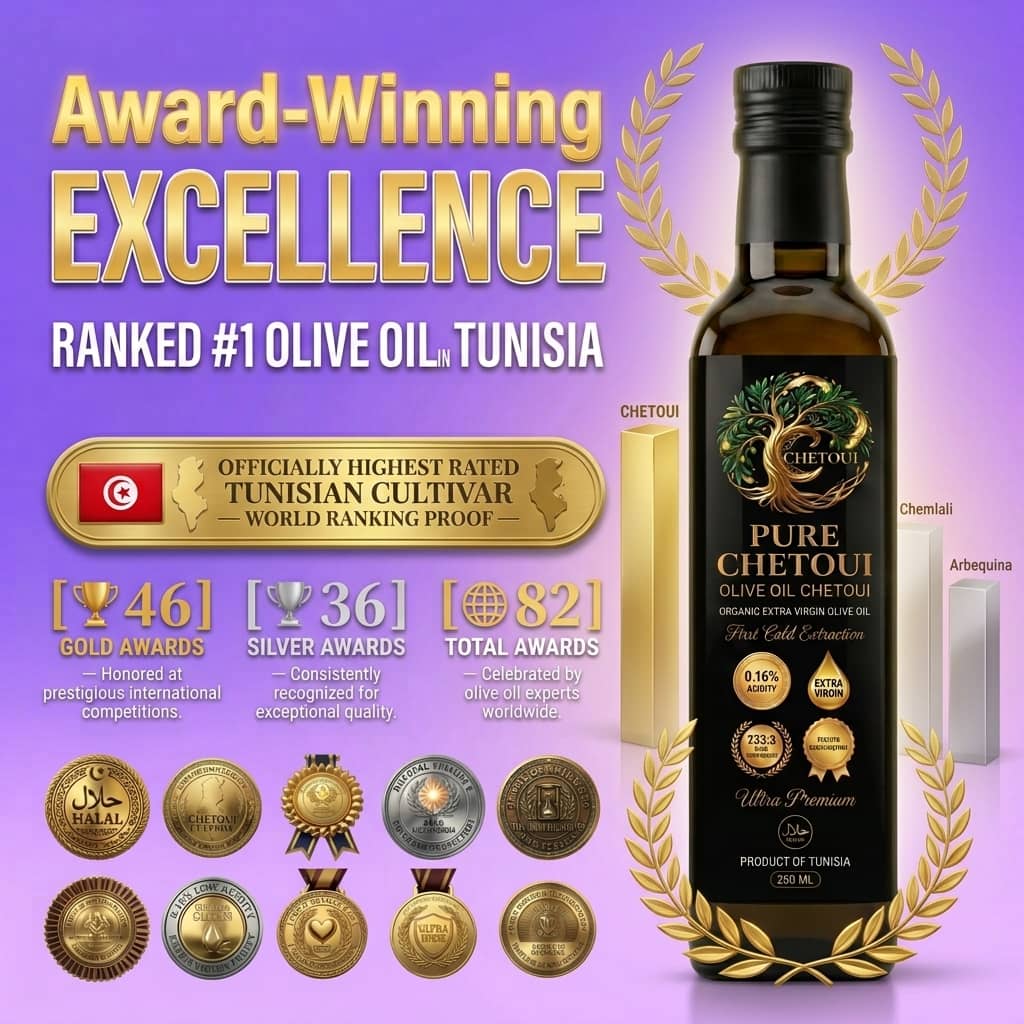
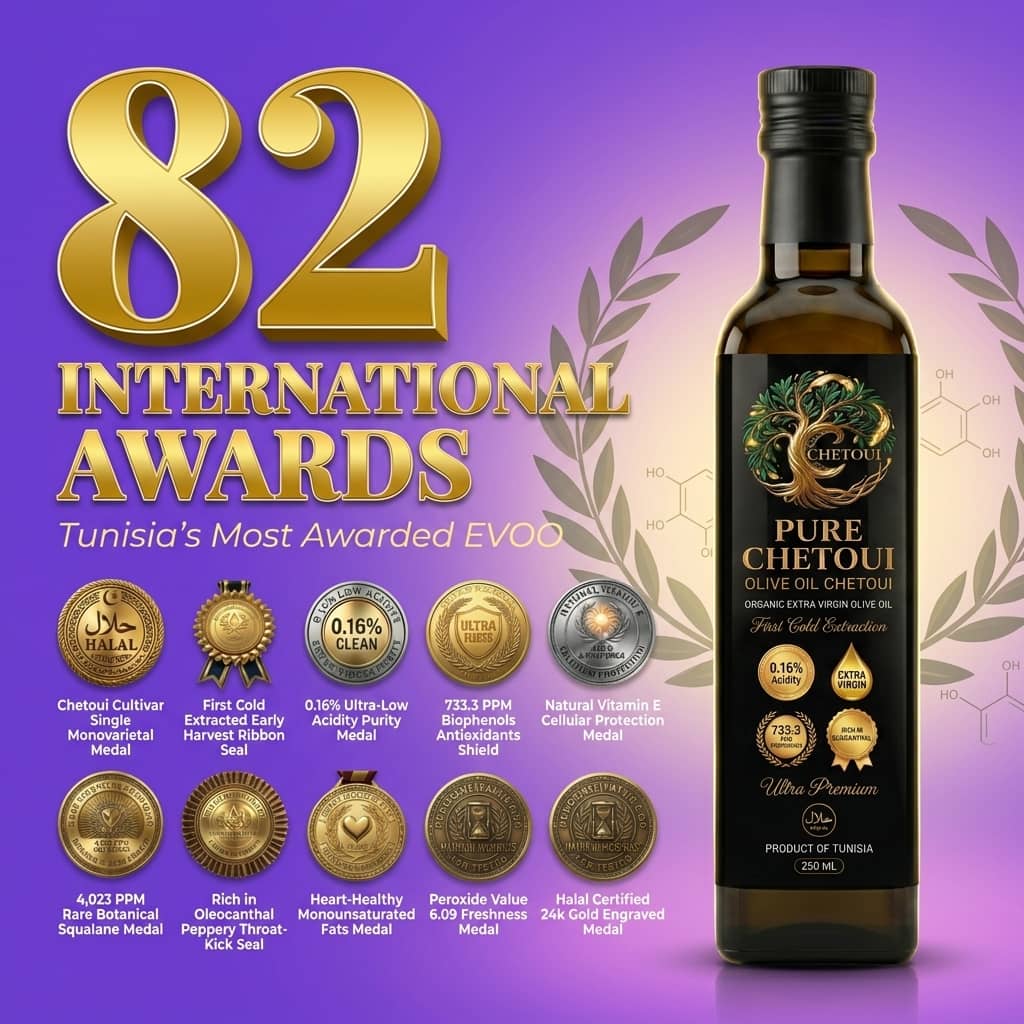
Among all the cultivars featured in NYIOOC olive oil competition results over the years, the Chetoui cultivar from Northern Tunisia stands out with an extraordinary record: 82 total awards comprising 46 Gold and 36 Silver medals. This is not a single producer’s achievement — it represents the collective performance of Chetoui olive oil across multiple producers, farms, and harvest years. It is the kind of consistent excellence that best olive oil awards are designed to identify.
This record reveals several important truths about the Chetoui cultivar:
- Consistency over time: Winning one award could be attributed to a fortunate harvest or a skilled producer having a great year. Winning 82 times across multiple years, harvests, and producers proves that the cultivar itself consistently produces world-class oil. This kind of repeatability is what separates a great cultivar from a lucky bottle.
- Flavour profile that judges reward: Chetoui’s intensely green fruitiness, pronounced bitterness, and strong peppery finish are precisely the attributes that score highest in professional sensory assessment. The cultivar’s natural flavour profile is essentially optimised for competition judging.
- Polyphenol superiority: The same characteristics that judges score highly — intense bitterness and strong pungency — are direct, reliable indicators of exceptionally high polyphenol content. Competition performance and health value are not separate qualities; they arise from the same biochemistry.
- Terroir validation: Northern Tunisia’s specific combination of Mediterranean climate, limestone-rich soils, altitude, and temperature variation creates growing conditions that competition results repeatedly validate as exceptional for producing premium olive oil.
When you choose a Chetoui olive oil like Pure Chetoui, you are selecting a cultivar with arguably the strongest track record of any single variety at the highest level of international olive oil competition. That 82-award record is not marketing — it is verified, publicly searchable fact.
Why NYIOOC Olive Oil Competition Results Matter More Than Marketing Claims
The global olive oil market is saturated with aspirational marketing language. Bottles routinely carry words like “premium,” “artisan,” “finest quality,” “hand-picked,” “first cold press,” and “from the Mediterranean.” These phrases sound impressive but carry zero verifiable meaning. Any producer can print them on any label. NYIOOC olive oil competition results provide the objective, third-party validation that cuts through this noise.
Here is why competition results are fundamentally more trustworthy than marketing:
- Blind judging eliminates brand bias: Judges never see the bottle, the label, the brand name, or the price tag. There is no possibility of being influenced by packaging design or reputation. The oil is judged purely on what is inside the bottle.
- Expert assessment vs consumer perception: Trained sensory analysts with IOC certification evaluate the oil using calibrated scientific methodology, not the subjective preferences that marketing is designed to exploit.
- Published, verifiable results: Every result is publicly available at bestoliveoils.org. You can verify any brand’s claims in minutes. No other quality claim in the olive oil industry offers this level of transparency.
- Annual re-evaluation: Awards reflect the current or recent harvest season, not historical reputation built years ago. A brand must re-earn its awards with every new harvest. Past performance does not guarantee future recognition.
When a brand can point to both competition awards AND independently lab-tested chemical parameters (polyphenols, acidity, peroxide value), you have double verification — sensory quality confirmed by human experts combined with chemical quality confirmed by accredited laboratory analysis. This dual confirmation is the strongest evidence of quality available to consumers.
The Lab Numbers Behind the Awards: Chemical Proof of Quality
Competition awards tell you about sensory quality. Laboratory analysis tells you about chemical quality. The best olive oils demonstrate excellence in both dimensions. Here are the lab-certified numbers for Pure Chetoui extra virgin olive oil, which exemplifies the quality profile behind NYIOCC awards olive oil experts celebrate:
| Quality Parameter | Pure Chetoui Result | EVOO Limit (IOC) | What It Means |
|---|---|---|---|
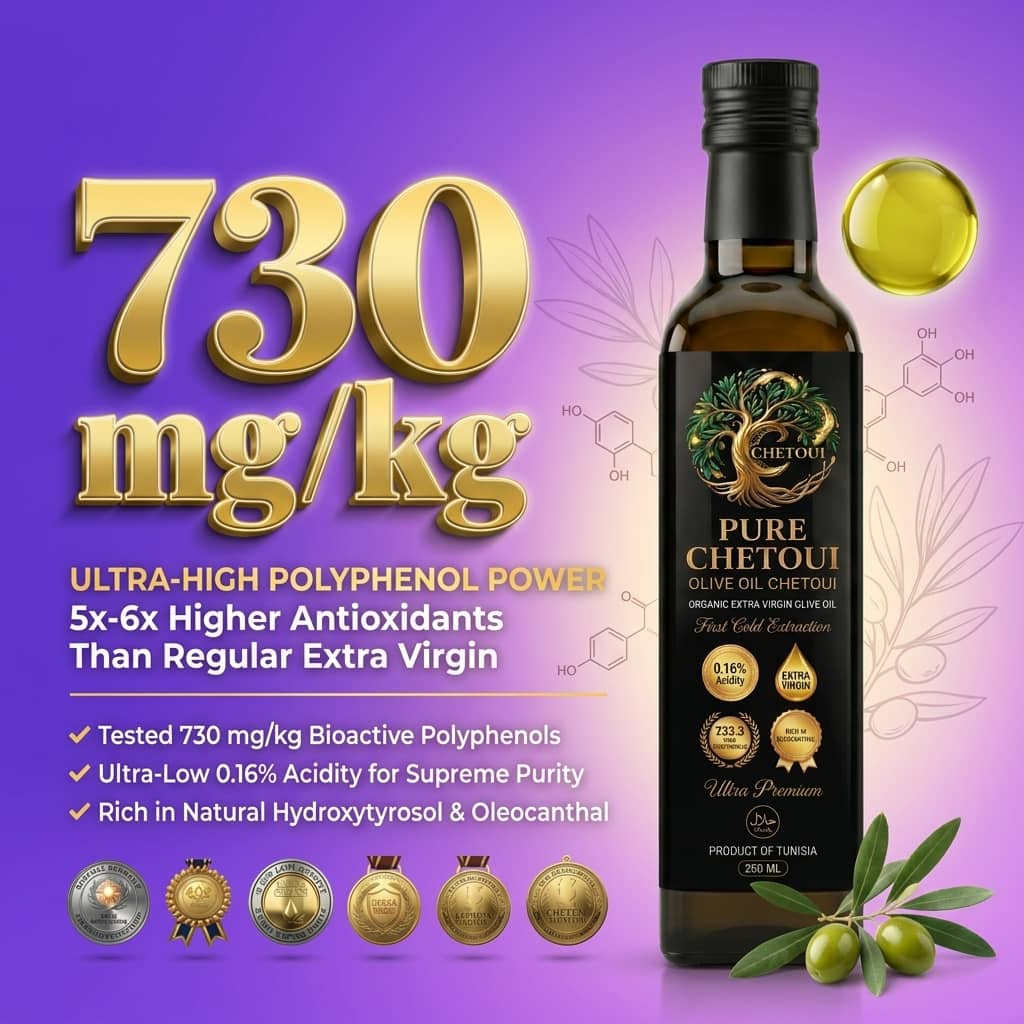
| Biophenols (Polyphenols) | 733.3 ppm | No minimum set | Exceptionally high — EU health claim threshold is just 250 ppm. Nearly 3x the minimum for health benefits. |
| Free Fatty Acidity (FFA) | 0.16% | < 0.8% | Extremely low — indicates perfect handling from harvest to bottle. Five times better than the EVOO maximum. Learn more about what acidity tests reveal about olive oil quality. |
| Peroxide Value | 6.09 meq O2/kg | < 20 | Very low — indicates minimal oxidation. The oil is exceptionally fresh and well-preserved. |
| Oleic Acid | 65.24% | 55-83% | Solidly within the optimal range, indicating healthy monounsaturated fat composition and good oxidative stability. |
These numbers tell a clear story. The 733.3 ppm biophenol count confirms what competition judges taste when they detect intense bitterness and pungency. The 0.16% free fatty acidity proves that the olives were harvested at the right time, transported quickly, and processed within hours — the kind of meticulous handling that produces both award-winning flavour and exceptional chemical quality. The low peroxide value confirms that the oil has been protected from oxidation throughout the entire production chain.
This is the dual evidence standard that the most discerning consumers and the best olive oil awards programmes both point to: competition medals verify what your palate experiences, and lab certificates verify what your body receives.
How to Use NYIOOC Results When Buying Olive Oil
Armed with an understanding of what NYIOOC olive oil competition results represent, here is a practical, step-by-step guide for using them as a buying tool — particularly relevant for Malaysian consumers navigating an imported olive oil market where quality verification is difficult:
- Search for the brand or cultivar at bestoliveoils.org: Before buying any olive oil that claims to be premium, check whether the brand or its cultivar has NYIOOC recognition. The database at bestoliveoils.org is free, public, and searchable by brand name, country of origin, or cultivar variety.
- Prioritise Gold over Silver: Gold indicates truly exceptional quality — the top tier of world competition. Silver indicates excellent quality that is still well above commercial standards. Either is a strong indicator, but Gold represents the highest achievable standard. No award means the brand’s quality claim is unverified by the world’s most rigorous assessment.
- Check the award year: Olive oil is a perishable agricultural product. Awards from five or more years ago do not guarantee that the current bottle in your hand is the same quality. Look for recent results from the last one to two harvest seasons. Consistent awards across multiple years are the strongest signal.
- Cross-reference with lab analysis: Competition awards confirm sensory quality. Lab certificates (polyphenol count, acidity, peroxide value) confirm chemical quality. The most trustworthy producers provide both. If a brand has awards but refuses to share lab numbers, ask why. If they share lab numbers but have no competition awards, the numbers are unverified by independent expert assessment.
- Verify award claims independently: Some brands in the Malaysian market claim international awards they have never actually won. Because NYIOOC results are publicly searchable, you can verify any claim in under a minute. Never accept an award claim at face value — especially if the bottle design prominently features medals or ribbons but provides no specific competition name or year.
- Consider the cultivar track record: Some cultivars consistently outperform others in competition. The Chetoui cultivar’s 82-award record, for example, tells you that any well-made Chetoui oil has a high probability of genuine quality because the cultivar’s inherent flavour profile is competition-optimised.
Other Olive Oil Competitions Worth Knowing
While the NYIOOC is the most prestigious and widely recognised olive oil competition in the world, several other respected competitions provide additional quality validation. Olive oil competition winners that perform consistently across multiple independent competitions demonstrate the most reliable and reproducible quality. Here are the other major competitions to know:
- JOOP (Japan Olive Oil Prize): Asia’s premier olive oil competition, particularly influential in the Japanese and broader Asian market. Japanese consumers are among the world’s most quality-conscious olive oil buyers, making this competition’s standards especially rigorous.
- Olive Japan: Another highly respected Japanese competition with growing international recognition. Its separate judging panel provides an independent quality confirmation alongside JOOP.
- Berlin GOOA (Global Olive Oil Awards): A European-focused competition with rigorous standards and strong participation from Mediterranean producers. Important for European market recognition.
- Mario Solinas Award: Awarded by the International Olive Council (IOC) itself — the intergovernmental body that sets the global standards for olive oil classification. Winning the Mario Solinas is recognition from the very institution that defines what “extra virgin” means.
- Sol d’Oro: One of Italy’s oldest and most respected olive oil competitions, with particularly strong participation from Italian and Mediterranean basin producers.
The Chetoui cultivar consistently performs well across all of these major competitions, not just the NYIOOC. This multi-competition consistency is the strongest possible evidence that the cultivar produces inherently outstanding olive oil regardless of which panel of experts evaluates it.
What Separates Olive Oil Competition Winners from the Rest
If 70% of NYIOCC entries receive no award, what exactly separates the best olive oil awards winners from everyone else? The differences come down to several critical factors that operate across the entire production chain, from grove to bottle:
Cultivar Selection
Not all olive varieties are created equal. Some cultivars — like Chetoui, Picual, and Koroneiki — are inherently richer in polyphenols and produce more intense, complex flavour profiles. Others, like Arbequina, tend to produce milder, softer oils that may appeal to casual consumers but rarely reach the intensity that competition judging rewards. Cultivar choice is arguably the single most important quality decision a producer makes.
Harvest Timing
Early harvest (when olives are still green or just turning colour) produces oils with higher polyphenol content, more intense green fruitiness, and sharper bitterness and pungency. Late harvest produces more oil per kilogram of fruit but with significantly lower polyphenol levels and less complex flavour. Competition-winning producers almost always harvest early, accepting lower yield in exchange for superior quality.
Processing Speed
The time between picking and pressing is critical. Every hour that olives sit after harvest, enzymatic degradation reduces quality. Competition-winning producers typically process within two to four hours of harvest. Mass-market producers may wait days. This is why the free fatty acidity level is such a powerful quality indicator — low FFA (like Pure Chetoui’s 0.16%) proves rapid processing.
Temperature Control
Cold extraction (below 27 degrees Celsius) preserves volatile aromatic compounds and heat-sensitive polyphenols. Higher temperatures increase yield but destroy the very compounds that judges evaluate and that deliver health benefits. Every degree matters in competition-quality production.
Storage and Handling
Even perfectly made oil can be ruined by exposure to light, heat, or oxygen during storage and shipping. Olive oil competition winners maintain strict protocols: inert gas blanketing in storage tanks, dark glass or tin packaging, temperature-controlled shipping. These practices protect the oil’s quality from production facility to your kitchen shelf.
Frequently Asked Questions About NYIOOC Olive Oil Competition Results
Can I verify NYIOOC olive oil competition results myself?
Yes, absolutely. All NYIOOC results are published publicly at bestoliveoils.org. You can search by brand name, country of origin, or cultivar to see exactly which awards were won and in which competition year. The database is free to access and updated annually. Never take any brand’s award claim at face value — always verify it against the official published results. If a brand claims NYIOOC recognition and you cannot find it in the database, the claim is almost certainly false.
Does winning an NYIOOC award mean the oil is the “best” for health benefits?
NYIOOC judges evaluate sensory quality — taste, aroma, defects, and harmony — not chemical health markers directly. However, there is a strong and well-documented correlation between the two. The attributes that judges reward most highly (bitterness from polyphenols, pungency from oleocanthal) are precisely the compounds that scientific research has linked to cardiovascular protection, anti-inflammatory effects, and neuroprotective benefits. An oil with high polyphenol content will almost always score well in competition because polyphenols are what create the bitterness and pungency that judges evaluate. High competition scores and high health value genuinely go hand in hand.
Why don’t more Malaysian consumers know about NYIOOC competition results?
Most olive oil sold in Malaysia reaches consumers through supermarket channels that prioritise low price over verified quality. Competition-winning oils are premium products that do not compete on price with mass-market bottles. Supermarkets typically stock the cheapest available imports, which are rarely competition winners. As Malaysian consumers become more educated about how to distinguish genuine olive oil from inferior products and more focused on health-driven food choices, awareness of competition results as a quality verification tool is growing significantly. The shift is accelerating as more consumers discover that “extra virgin” on a supermarket label frequently does not mean what they think it means.
How many Chetoui olive oils have won NYIOOC awards?
The Chetoui cultivar from Northern Tunisia has accumulated 82 total awards at the NYIOOC — 46 Gold and 36 Silver medals — across multiple producers, farms, and harvest years. This consistent performance from different producers working with the same cultivar confirms that it is the Chetoui variety itself, combined with Northern Tunisia’s unique terroir, that produces inherently world-class olive oil. It is not one exceptional producer — it is an exceptional cultivar growing in exceptional conditions.
How often does the NYIOOC competition take place?
The NYIOOC is held annually, typically in the spring (April to May) following the Northern Hemisphere olive harvest season. This timing means judges are evaluating oils from the most recent harvest, ensuring that results reflect current quality rather than historical reputation. The annual cycle also means producers must maintain their quality standards continuously — resting on previous years’ awards is not an option. Each competition cycle evaluates approximately 1,000 or more entries from over 28 countries, and the results are published within weeks of judging completion.
What is the difference between NYIOOC results and the IOC quality standards?
The International Olive Council (IOC) sets the regulatory baseline for olive oil classification — the minimum standards an oil must meet to be labelled “extra virgin.” These are pass/fail thresholds (acidity below 0.8%, no sensory defects, etc.). The NYIOOC, by contrast, evaluates how far above that baseline an oil performs. Think of the IOC standard as the exam pass mark and the NYIOOC as the distinction tier. An oil can legally be called “extra virgin” by meeting IOC minimums while still being mediocre compared to competition-winning oils. NYIOOC olive oil competition results identify oils that are not merely compliant but genuinely exceptional — and that distinction is what matters for consumers seeking the best quality and health benefits.
The Bottom Line: What NYIOOC Olive Oil Competition Results Tell You
In a market drowning in unverifiable quality claims, NYIOCC olive oil competition results stand apart as the most credible, transparent, and rigorous quality benchmark available. They represent blind expert assessment, publicly verifiable outcomes, and annual re-evaluation that holds producers to a consistent standard.
The Chetoui cultivar’s extraordinary 82-award record — 46 Gold and 36 Silver medals at the world’s most prestigious olive oil competition — is not a marketing story. It is a publicly documented achievement that any consumer can verify at bestoliveoils.org. When that competition pedigree is combined with laboratory-certified numbers like 733.3 ppm biophenols, 0.16% free fatty acidity, and a peroxide value of just 6.09, you have the most complete quality verification any olive oil can offer: award-winning taste confirmed by international experts and exceptional chemistry confirmed by accredited laboratories.
Pure Chetoui extra virgin olive oil — RM 109 for 250ml of organic, Chetoui-cultivar oil from Northern Tunisia — represents this dual standard of verified excellence. In a category where trust is scarce and misleading claims are everywhere, NYIOOC results and transparent lab data give you the confidence to know exactly what you are buying and exactly what you are putting on your table.

Related posts
Chetoui Olive Oil Tunisia — The Ultimate Guide

Chetoui olive oil Tunisia is the most polyphenol-rich single cultivar olive oil on Earth, consistently producing biophenol counts above 700 ppm while earning an astonishing 82 awards at the world's most prestigious olive oil competition.