
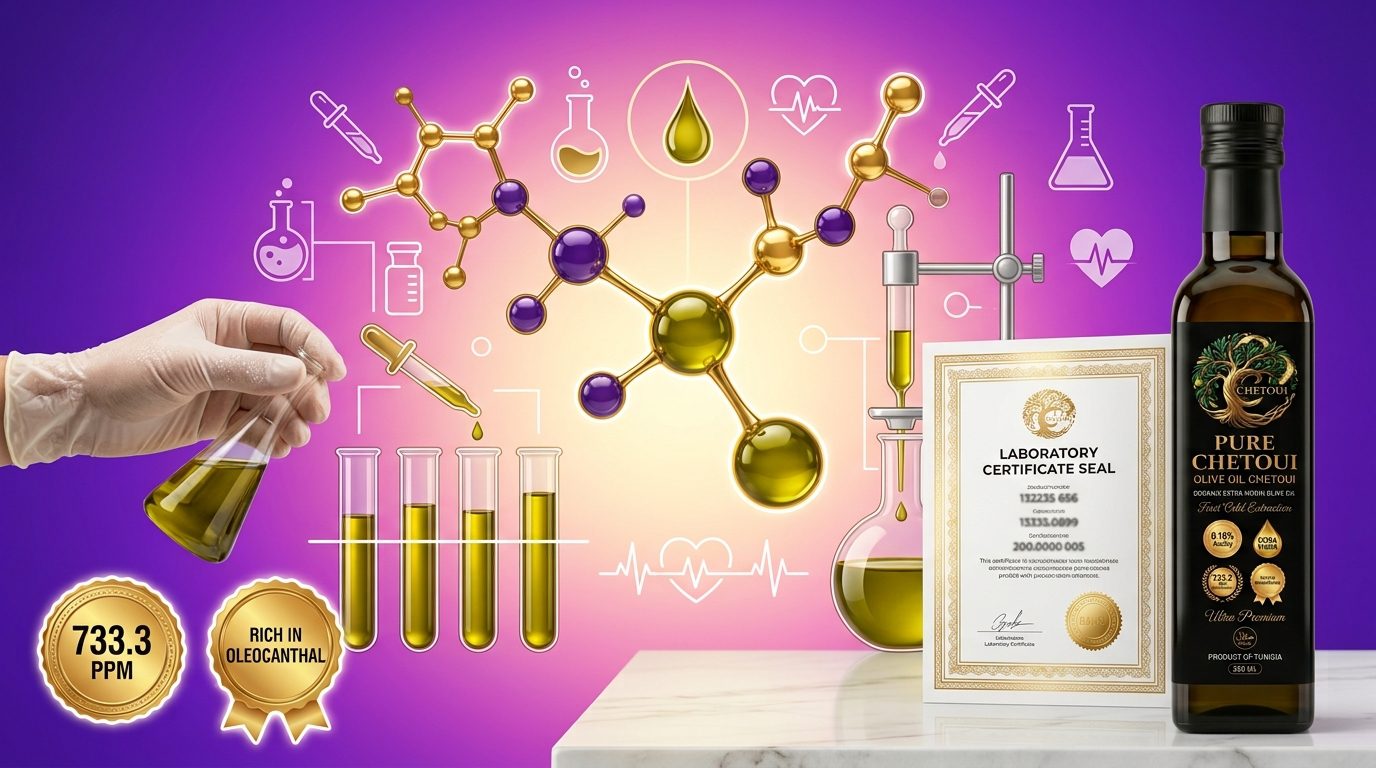
Extra Virgin Olive Oil Acidity Test — Essential Guide
Table of Contents
- What Does the Extra Virgin Olive Oil Acidity Test Measure?
- The Olive Oil Acidity Scale: IOC Grade Boundaries
- Why 0.16% FFA Is Exceptional Quality
- How to Read an Extra Virgin Olive Oil Acidity Test Report
- Olive Oil FFA Acidity and Your Health
- The Acidity-Polyphenol Connection
- Common Myths About Olive Oil Quality Testing
- Ujian Keasidan Minyak Zaitun: Panduan untuk Pembeli Malaysia
- Your Essential Buying Checklist for Malaysia
- Frequently Asked Questions
The extra virgin olive oil acidity test is the single most important laboratory measurement that separates genuinely premium olive oil from the mediocre bottles lining supermarket shelves. When you understand what this test reveals — and what the numbers actually mean — you gain the power to make informed purchasing decisions that protect both your health and your wallet. Most consumers in Malaysia have never seen an actual acidity test result, and that knowledge gap is precisely what low-quality brands exploit to sell inferior products at premium prices.
This essential guide explains everything you need to know about olive oil FFA acidity testing: what the numbers measure, how to interpret a lab report, why our Pure Chetoui achieves a remarkable 0.16% FFA, and how to use this knowledge to verify any olive oil before you buy. Whether you are new to premium olive oil or already familiar with high-polyphenol olive oil benefits, understanding the acidity test transforms how you evaluate quality.
The International Olive Council (IOC) sets the global standards for olive oil quality testing, and acidity is the first parameter on every official assessment. Let us break down what this critical test measures and why it matters so much.
What Does the Extra Virgin Olive Oil Acidity Test Measure?
The extra virgin olive oil acidity test measures free fatty acid (FFA) content, expressed as a percentage of oleic acid by weight. This is a chemical measurement performed in a laboratory through titration — it has absolutely nothing to do with how sour or acidic the oil tastes on your tongue.
Here is what happens at the molecular level: olive oil is primarily composed of triglycerides — three fatty acid chains bonded to a glycerol molecule. When these triglycerides break down, the fatty acid chains detach and become “free.” The acidity test counts how many fatty acids have broken free from their glycerol backbone.
Free fatty acids form when olive oil undergoes degradation. The primary causes include:
- Damaged olives — bruising during harvest ruptures cell walls, triggering enzymatic hydrolysis that releases free fatty acids immediately
- Delayed processing — olives sitting in storage bins for days before reaching the mill, allowing fermentation and microbial degradation to begin
- Insect damage — olive fly (Bactrocera oleae) larvae bore tunnels through the fruit, creating oxidation pathways before the olive is even harvested
- Fungal infection — moulds such as Aspergillus and Penicillium attack damaged fruit, accelerating lipase activity and fatty acid liberation
- Excessive heat during extraction — temperatures above 27 degrees Celsius during malaxation speed chemical degradation
- Poor storage conditions — exposure to heat, light, and oxygen after extraction continues the breakdown process over weeks and months
- Natural ageing — even properly stored oil gradually accumulates free fatty acids as triglycerides slowly hydrolyse over time
In the simplest terms: lower acidity equals less damage equals fresher, more carefully handled oil. The acidity number is essentially a report card on every step of the production chain — from the health of the tree to the conditions inside the bottle on the shelf.

The Olive Oil Acidity Scale: IOC Grade Boundaries
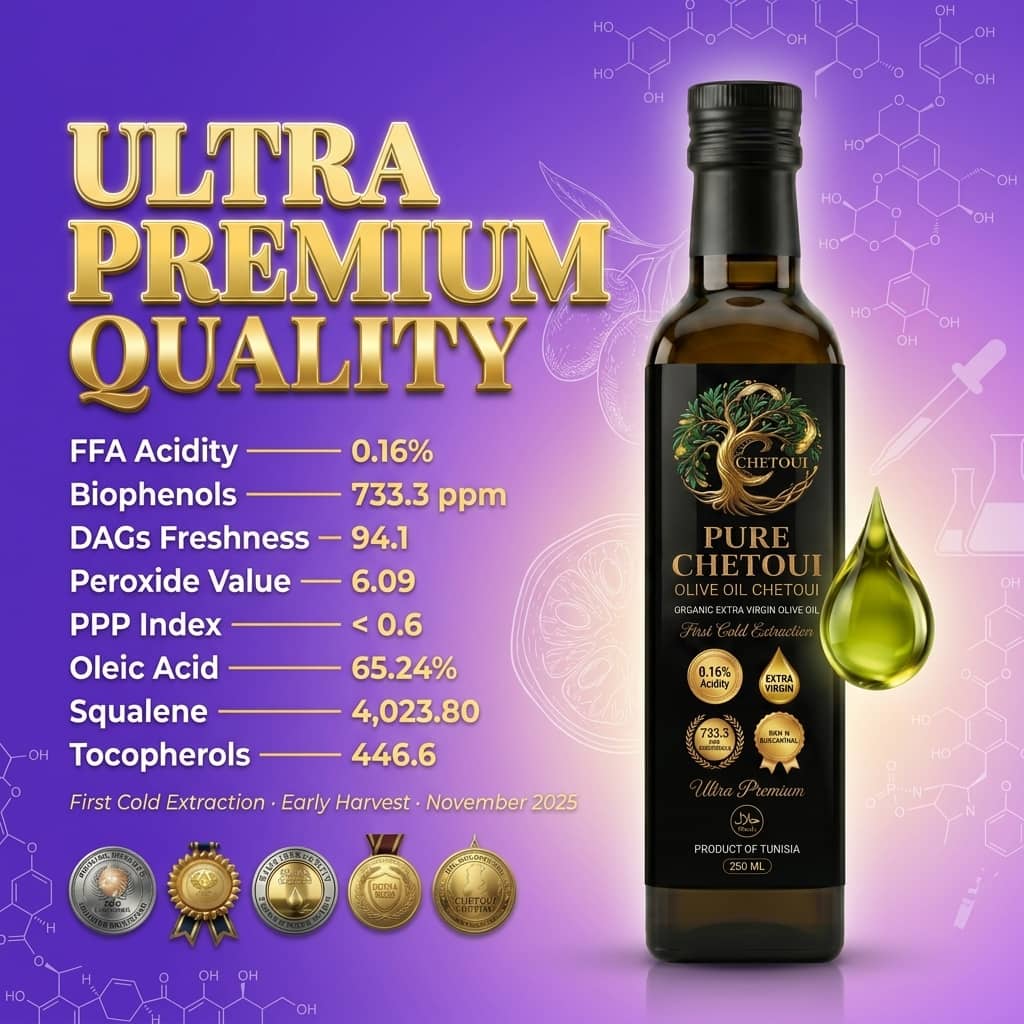
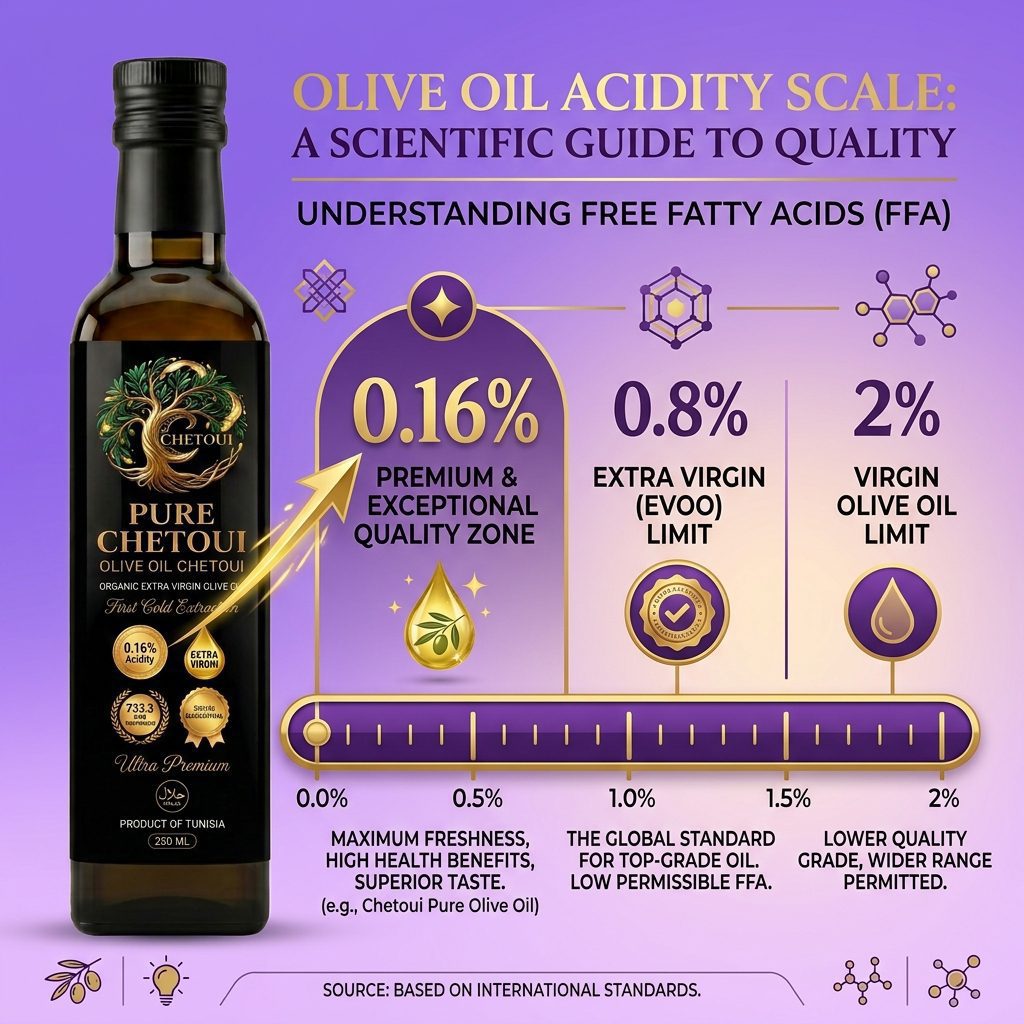
The International Olive Council establishes clear grade boundaries based on olive oil FFA acidity levels. Understanding these thresholds is essential for any consumer serious about olive oil quality testing:
| Grade | Maximum FFA (%) | Quality Indication |
|---|---|---|
| Ultra-Premium EVOO | Below 0.2% | Exceptional — olives pressed within hours, zero compromise |
| Premium EVOO | 0.2% – 0.3% | Excellent — careful handling, quick processing |
| Good EVOO | 0.3% – 0.5% | Above average — reasonable care in production |
| Standard EVOO | 0.5% – 0.8% | Barely qualifying — common in supermarket brands |
| Virgin Olive Oil | 0.8% – 2.0% | Acceptable but with noticeable defects |
| Lampante (Not Edible) | Above 2.0% | Requires refining before consumption |
A critical distinction: refined olive oil can achieve FFA as low as 0.1%, but this low number is achieved through chemical processing — deodorisation, bleaching, and alkali neutralisation — that strips away every polyphenol, every flavour compound, and every health benefit. Low acidity through refining is fundamentally different from naturally low acidity achieved through excellent agricultural and production practices.
When evaluating olive oil quality testing results, always ask: is this low acidity natural or manufactured? The answer changes everything about the oil’s health value.
Why 0.16% FFA Is Exceptional Quality
Pure Chetoui’s laboratory-verified 0.16% FFA represents the top fraction of olive oils produced worldwide. Achieving this level of olive oil FFA acidity requires an unbroken chain of excellence at every production stage:
- Healthy, disease-free trees — the Chetoui cultivar in Northern Tunisia thrives in mineral-rich soils at elevation, naturally resistant to many common olive pests
- Early harvest timing — picking in early November 2025 when olives are still green and firm, before enzymatic degradation can begin. Early harvest sacrifices yield (less oil per olive) for dramatically higher quality
- Gentle mechanical harvesting — careful raking techniques that minimise bruising, because every bruise starts a degradation clock
- Immediate transport — from grove to mill within hours, not the days-long storage common in mass production
- Cold extraction below 27 degrees Celsius — preventing thermal degradation of both fatty acid bonds and delicate polyphenol compounds
- Processing within 4 hours of harvest — this is the critical factor. Most commercial operations process olives 24-72 hours after picking. Those extra hours dramatically increase FFA levels
- Nitrogen-blanketed stainless steel storage — inert gas prevents oxidation from the moment extraction is complete, preserving the oil in its freshest possible state
Any failure at any single step elevates the acidity. An oil at 0.16% represents perfection across the entire production chain — it is objective, measurable proof that zero compromises were made from tree to bottle.
Consider the mathematics: most supermarket extra virgin olive oils sit between 0.5% and 0.8% FFA. At 0.16%, Pure Chetoui has three to five times lower acidity than these common products. That difference is not marginal — it represents a fundamentally different approach to olive oil production.

How to Read an Extra Virgin Olive Oil Acidity Test Report
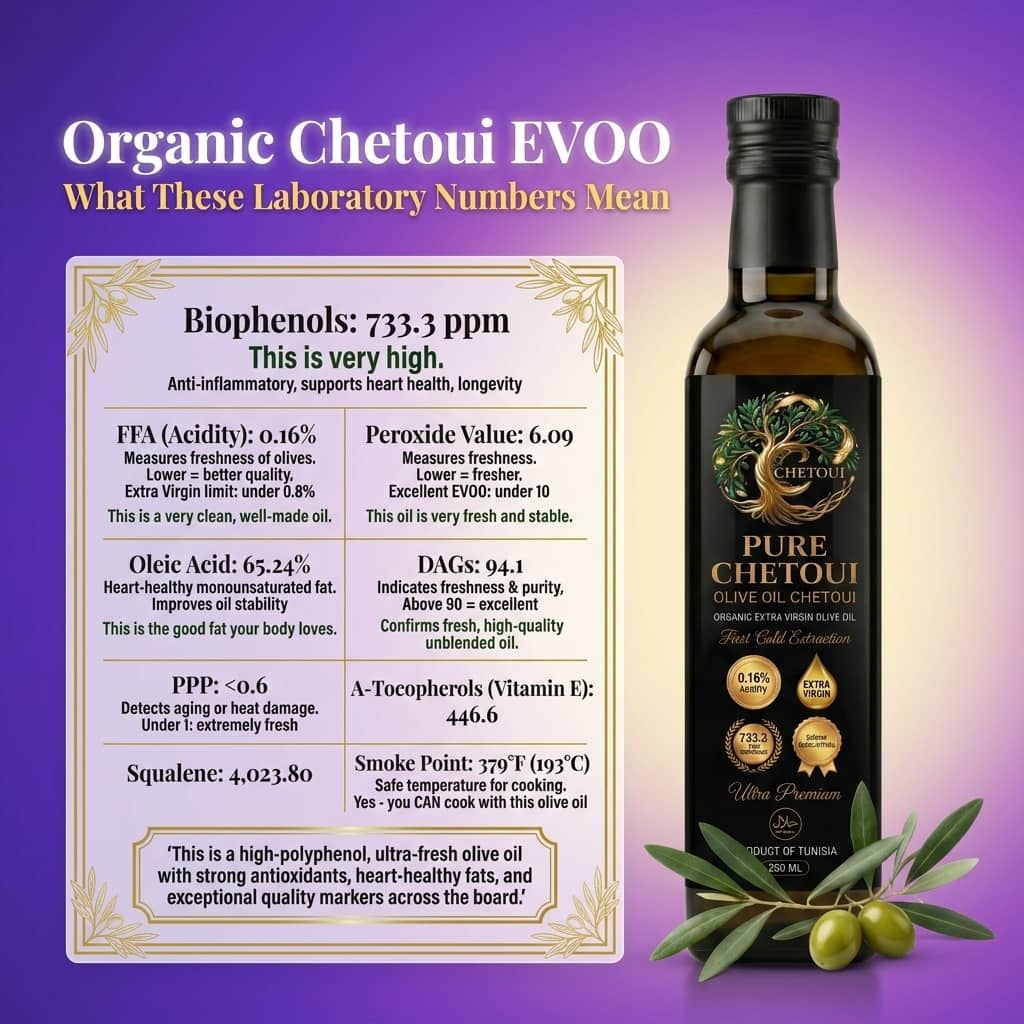
Understanding how to read an extra virgin olive oil acidity test report empowers you to evaluate any olive oil with confidence. A complete laboratory analysis should include these essential parameters:
1. Free Fatty Acid (FFA) / Acidity (%)
The primary quality marker. Must be below 0.8% for extra virgin classification. Below 0.3% indicates premium quality. Pure Chetoui’s verified result: 0.16%.
2. Peroxide Value (meq O2/kg)
Measures primary oxidation — how much the oil has been exposed to oxygen. The IOC maximum for extra virgin is 20 meq O2/kg. Below 10 is excellent, indicating fresh oil that has not been sitting in warehouses for months. Pure Chetoui’s verified result: 6.09 meq O2/kg.
3. Total Polyphenols / Biophenols (mg/kg or ppm)
The European Food Safety Authority (EFSA) established that olive oil polyphenols contribute to the protection of blood lipids from oxidative stress when consumption provides at least 5 mg of hydroxytyrosol and derivatives per day — achievable from oils above 250 ppm. Above 500 ppm is exceptional. Pure Chetoui’s verified result: 733.3 ppm biophenols. Learn more about what these compounds do in our guide to high-polyphenol olive oil benefits.
4. Oleic Acid Content (%)
The dominant fatty acid in olive oil, responsible for much of its cardiovascular health benefit. Higher oleic acid percentage indicates a more stable oil. Pure Chetoui’s verified result: 65.24%.
5. DAGs — 1,2-Diacylglycerols (%)
A freshness and authenticity marker. In fresh, unrefined olive oil, DAGs remain above 90%. Low DAGs suggest the oil has been refined, deodorised, or is simply old. Pure Chetoui’s verified result: 94.1%.
6. UV Absorption Values (K232, K270)
These spectrophotometric measurements detect refining and adulteration. Elevated K270 in particular suggests the oil has undergone chemical processing. Values above IOC thresholds disqualify the oil from extra virgin classification.
If a brand shows you a complete report with all these numbers from an accredited independent laboratory, you are looking at minyak zaitun asli — genuine olive oil. If they can only print “extra virgin” on the label without providing verifiable numbers, scepticism is warranted.
Complete Lab Profile: Pure Chetoui EVOO
| Parameter | Pure Chetoui Result | EVOO Limit (IOC) | Rating |
|---|---|---|---|
| Free Fatty Acid (FFA) | 0.16% | Below 0.8% | Exceptional |
| Peroxide Value | 6.09 meq O2/kg | Below 20 | Excellent |
| Biophenols | 733.3 ppm | No IOC minimum | Exceptional (EFSA: 250+) |
| Oleic Acid | 65.24% | 55% – 83% | Good |
| DAGs (1,2-Diacylglycerols) | 94.1% | Above 35% | Exceptional freshness |
Olive Oil FFA Acidity and Your Health
The olive oil FFA acidity level directly impacts the health benefits you receive from every tablespoon. Here is the science behind why lower acidity means greater benefit for your body.
Digestive Comfort and Stomach Health
Higher-acidity olive oils contain more free fatty acids that can irritate the gastric mucosa, especially when consumed on an empty stomach — a common practice in Mediterranean health traditions. Many people who experience heartburn or stomach discomfort with ordinary olive oil find that ultra-low acidity oils like Pure Chetoui at 0.16% cause zero digestive issues. The difference is significant enough that gastroenterologists in olive-producing countries routinely recommend low-acidity EVOO for patients with sensitive stomachs.
Superior Polyphenol Retention
Low acidity correlates directly with higher polyphenol preservation. The same meticulous handling that keeps FFA levels at 0.16% also protects the delicate polyphenol compounds — oleocanthal (the powerful anti-inflammatory compound), hydroxytyrosol, and oleuropein. An oil sitting at 0.7% acidity has typically lost a substantial portion of its polyphenols to enzymatic and oxidative degradation long before it reaches your kitchen.
Extended Freshness and Shelf Life
Lower-acidity oils have significantly more oxidative stability, meaning they resist rancidity and stay fresh longer once opened. An oil starting at 0.16% FFA has enormous “headroom” before it degrades past the 0.8% extra virgin threshold. Compare that to an oil already at 0.6% — it is already three-quarters of the way to losing its extra virgin status the moment you open the bottle.
Flavour Quality and Sensory Profile
Ultra-low acidity oils deliver cleaner, more defined flavour profiles: pronounced fruitiness, balanced bitterness from polyphenols, and the distinctive peppery throat catch from oleocanthal. Higher-acidity oils taste flat, greasy, or subtly rancid — flavour defects indicating degradation has already compromised the oil. The Chetoui cultivar at 0.16% FFA expresses bold, herbaceous intensity that cheaper oils simply cannot match.
Cardiovascular and Cellular Protection
Research published in peer-reviewed journals consistently demonstrates that high-polyphenol, low-acidity extra virgin olive oil provides greater cardiovascular protection than standard olive oil. The combination of intact polyphenols, minimal oxidation products, and high oleic acid content at 65.24% creates the maximum health benefit per serving.
The Acidity-Polyphenol Connection
Many consumers focus on either acidity or polyphenols alone, but these two parameters are deeply interconnected. Understanding this relationship is essential for olive oil quality testing evaluation.
The conditions that produce low acidity — early harvest, immediate processing, cold extraction, careful handling — are exactly the same conditions that preserve polyphenols. This is not coincidental. Both metrics reflect the same underlying reality: how much degradation has occurred.
When olives are damaged, enzymes like lipase break down triglycerides (raising FFA) while simultaneously, oxidase enzymes degrade phenolic compounds (lowering polyphenols). The two processes happen in parallel. This is why you almost never find a low-acidity oil with low polyphenols, or a high-polyphenol oil with high acidity — the chemistry does not allow it.
Pure Chetoui exemplifies this connection perfectly: 0.16% FFA paired with 733.3 ppm biophenols. Both numbers tell the same story of meticulous production. This oil has been recognised at the NYIOOC World Olive Oil Competition, where the producer’s oils have earned 82 awards — a validation of the quality that these laboratory numbers predict.
Common Myths About Olive Oil Quality Testing
Misinformation about olive oil acidity and olive oil quality testing is rampant, especially online. Let us address the most persistent myths with scientific clarity.
Myth 1: “Acidity means the oil tastes sour or acidic”
This is the most widespread misunderstanding. FFA acidity is a chemical measurement performed through laboratory titration — you cannot taste free fatty acid levels directly. What you can taste is rancidity (an oxidation defect) and the peppery throat sensation from oleocanthal (a sign of quality, not deficiency). Ironically, a technically high-acidity oil might taste deceptively “smooth” because it has been refined — smoothness is not always a positive indicator.
Myth 2: “Refined oil with 0.1% acidity is better than EVOO at 0.3%”
Absolutely not. Refining achieves low acidity numbers by chemically stripping the oil through alkali neutralisation, bleaching, and deodorisation — processes that remove every polyphenol, every flavour compound, and every health-promoting substance. A naturally low-acidity EVOO at 0.16% and a refined oil at 0.1% are fundamentally different products. The EVOO retains its full polyphenol profile; the refined oil is nutritionally closer to a neutral seed oil.
Myth 3: “I can test olive oil acidity at home”
No reliable home test for acidity exists. The fridge test (real olive oil solidifies in the fridge), the burn test (real olive oil burns with a clean flame), and the water test have all been thoroughly debunked by olive oil scientists at the University of California Davis Olive Center and other research institutions. These tests cannot distinguish between extra virgin olive oil and refined olive oil blended with a small amount of virgin oil for colour and flavour.
The only reliable extra virgin olive oil acidity test requires proper laboratory equipment — specifically titration with standardised potassium hydroxide (KOH) solution following the IOC official method. This is precisely why demanding lab certificates from producers matters so much.
Myth 4: “All extra virgin olive oils are the same quality”
The extra virgin classification spans an enormous quality range. An oil at 0.79% FFA barely qualifies and has likely lost most of its polyphenols, while an oil at 0.16% represents the pinnacle of production excellence. Treating all extra virgin oils as interchangeable is like treating all passing exam scores as identical — a 51% pass and a 99% pass represent very different levels of achievement.
Myth 5: “Green colour means low acidity and high quality”
Colour tells you nothing reliable about acidity. Chlorophyll content (which creates green colour) varies by cultivar, harvest time, and growing conditions. Some producers even add olive leaves during extraction to artificially enhance green colour. The only way to verify acidity is through laboratory analysis — never by visual inspection.
Ujian Keasidan Minyak Zaitun: Panduan untuk Pembeli Malaysia
Bagi pembeli di Malaysia, memahami ujian keasidan minyak zaitun adalah penting untuk membezakan produk berkualiti tinggi daripada yang rendah. Pasaran Malaysia dibanjiri dengan minyak zaitun yang mendakwa “extra virgin” tanpa bukti makmal yang sah.
Berikut adalah apa yang perlu anda periksa pada setiap botol:
- Laporan makmal pihak ketiga — jenama yang sah menyediakan keputusan ujian daripada makmal bertauliah. Jika tiada nombor disediakan, berhati-hatilah.
- FFA di bawah 0.3% — ini menunjukkan kualiti premium sebenar, bukan sekadar memenuhi had minimum 0.8%
- Tarikh tuai dan sumber — minyak berkualiti menyatakan bila dan di mana zaitun dituai. Pure Chetoui diproses dalam masa 4 jam selepas penuaian pada November 2025
- Kandungan polifenol — melebihi 250 ppm untuk memenuhi tuntutan kesihatan EFSA. Pure Chetoui: 733.3 ppm
Untuk panduan lengkap tentang membezakan minyak zaitun asli daripada palsu di Malaysia, baca artikel kami tentang minyak zaitun asli vs palsu.
Your Essential Buying Checklist for Malaysia
Armed with your knowledge of the extra virgin olive oil acidity test and what the numbers mean, use these benchmarks when evaluating any olive oil for purchase:
Premium Quality Indicators (Look For These)
- FFA below 0.3% — genuine premium quality verified by laboratory analysis
- Peroxide value below 10 meq O2/kg — fresh oil, not aged stock sitting in warehouses or shipping containers for months in tropical heat
- Polyphenols above 300 ppm — real, measurable health benefits backed by EFSA science, not just marketing claims
- DAGs above 90% — confirms both freshness and the complete absence of refining
- Harvest date on the label — producers proud of their freshness state when the olives were picked
- Named cultivar and origin — traceability from grove to bottle
- Cold extraction stated — processing below 27 degrees Celsius is essential for quality preservation
Warning Signs (Avoid These)
- No lab report available — the single biggest red flag. Brands with excellent numbers always publish them
- “Light” or “pure” olive oil labels — these are refined products, not extra virgin
- No harvest date — the oil could be years old
- Unusually cheap pricing — genuine ultra-low acidity EVOO requires expensive early-harvest and rapid-processing techniques. Bargain prices almost always indicate compromised quality
- “Product of [multiple countries]” — blended oils from various sources are nearly impossible to quality-control consistently
Pure Chetoui publishes every number: 0.16% FFA, 6.09 peroxide value, 733.3 ppm biophenols, 65.24% oleic acid, 94.1% DAGs. Every parameter verified by an independent accredited laboratory. Northern Tunisian Chetoui cultivar, early November 2025 harvest, cold extracted within 4 hours. Available at RM 109 for 250ml — the price reflects the genuine cost of ultra-premium production where no shortcut is taken.
Frequently Asked Questions
What is a good acidity level for extra virgin olive oil?
Below 0.3% FFA is considered premium quality. The legal maximum for extra virgin classification is 0.8%, but oils near that limit are barely qualifying and have typically lost significant polyphenol content. The best producers in the world achieve 0.1% to 0.2% through early harvest, immediate processing within hours, and cold extraction. Pure Chetoui’s 0.16% places it in the top tier of global production.
Can I test olive oil acidity at home?
No. Reliable FFA testing requires laboratory titration equipment and standardised reagents following IOC-approved methods. Home tests circulating online — the fridge test, flame test, water test, and skin absorption test — have been scientifically debunked and cannot determine acidity, purity, or even whether an oil is truly extra virgin. The only trustworthy approach is requesting third-party lab certificates from the producer.
Does lower acidity mean the olive oil is healthier?
Yes, when the low acidity is natural (not achieved through refining). Naturally low-acidity EVOO retains more polyphenols and antioxidants, causes less gastric discomfort, resists oxidation and rancidity for longer shelf life, and indicates the olives were handled with exceptional care from harvest to bottle. The EFSA has confirmed that olive oil polyphenols protect blood lipids from oxidative stress — and low-acidity oils consistently contain more of these protective compounds.
Why do some olive oil brands not show their acidity level?
Because the number would expose low quality. Brands achieving premium acidity levels below 0.3% always display their results prominently — it is a powerful marketing advantage. If a brand hides this number, does not have laboratory testing, or deflects questions about their chemical analysis, it most likely means their FFA is close to the 0.8% legal limit or possibly even above it, which would disqualify the oil from extra virgin status entirely.
What is the difference between FFA acidity and pH acidity?
These are completely different measurements. FFA (free fatty acid) acidity in olive oil measures the percentage of fatty acids that have separated from their glycerol backbone — it indicates oil degradation and quality. pH measures hydrogen ion concentration in aqueous (water-based) solutions. Olive oil is not water-based, so pH measurement is not applicable or meaningful. When olive oil professionals discuss “acidity,” they exclusively mean FFA percentage, never pH.
How often should olive oil be tested for acidity?
Reputable producers test each harvest batch and each production lot. Since acidity can increase during storage, premium producers like those behind Pure Chetoui also conduct periodic re-testing to ensure the oil maintains its quality grade throughout its shelf life. As a consumer, look for lab reports dated close to the harvest date and check that the report specifically names the batch or lot number matching your bottle. Annual testing alone is insufficient for brands claiming ultra-premium quality.