
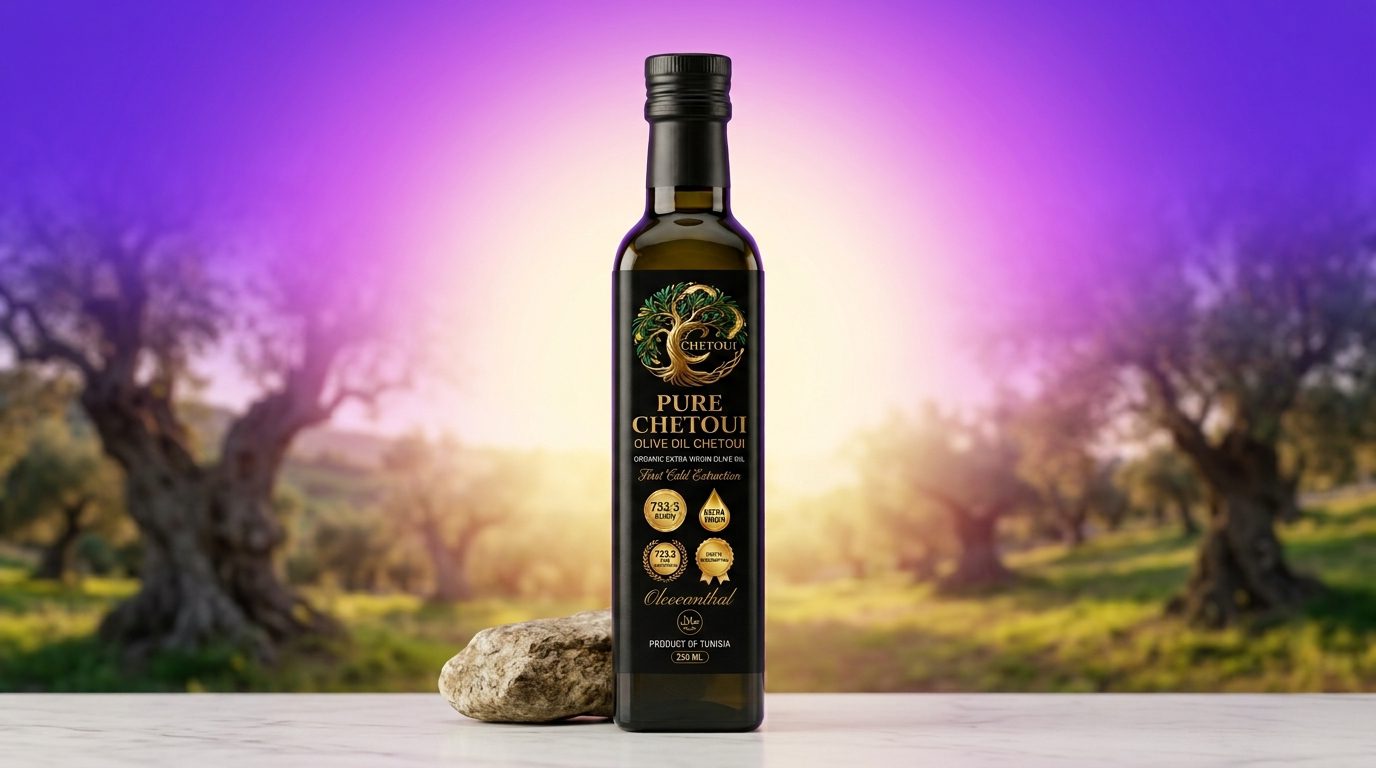
Chetoui olive oil Tunisia is the most polyphenol-rich single cultivar olive oil on Earth, consistently producing biophenol counts above 700 ppm while earning an astonishing 82 awards at the world’s most prestigious olive oil competition. If you have been searching for the highest-quality extra virgin olive oil backed by science and international recognition, the Chetoui cultivar from Northern Tunisia deserves your full attention.
In this ultimate guide, you will discover everything about the Chetoui cultivar: its ancient origins, its competition-dominating track record, its laboratory-verified polyphenol content, and why Tunisian olive oil from this specific variety outperforms famous European cultivars. Whether you are a health-conscious consumer, a gourmet chef, or someone exploring minyak zaitun Tunisia for the first time, this article gives you the complete picture.
Table of Contents
- What Is the Chetoui Cultivar? Origin and History
- Tunisia: The World’s Quiet Olive Oil Powerhouse
- Chetoui Olive Oil Tunisia: 82 International Awards at NYIOOC
- Why Chetoui Olive Oil Tunisia Produces the Highest Polyphenols
- Laboratory Analysis: 733 ppm Biophenols and Complete Chemical Profile
- Chetoui vs Other Popular Olive Cultivars
- The Flavour Profile of Chetoui Olive Oil
- Health Benefits of High-Polyphenol Chetoui Olive Oil
- How to Buy Authentic Chetoui Olive Oil Tunisia
- How Pure Chetoui Brings This to Malaysia
- Frequently Asked Questions About Chetoui Olive Oil Tunisia
What Is the Chetoui Cultivar? Origin and History
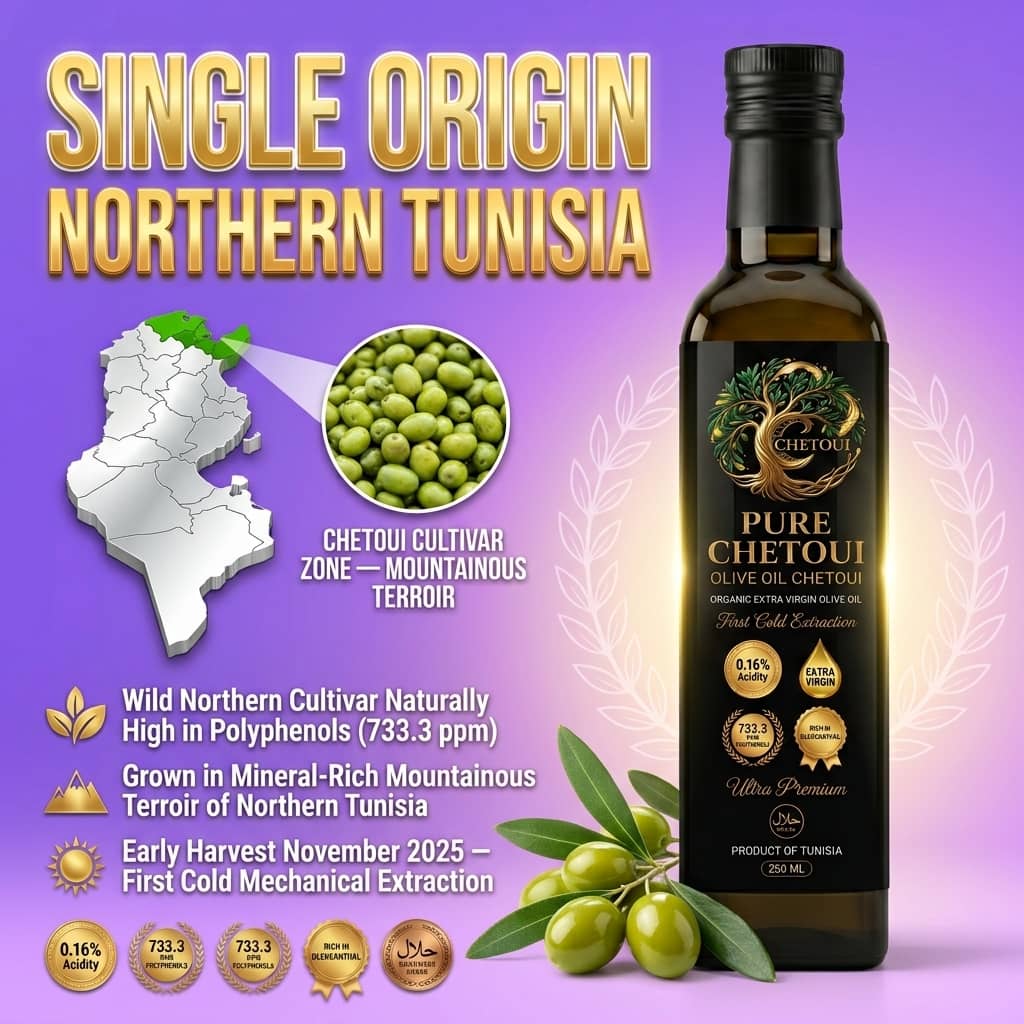
Chetoui (pronounced “sheh-TOO-ee”) is an olive variety indigenous to Northern Tunisia. It is one of the oldest olive cultivars in the Mediterranean basin, with archaeological evidence suggesting continuous cultivation for over 2,500 years. The Chetoui cultivar thrives in the mountainous terrain of Tunisia’s northern regions — areas defined by cold winters, hot summers, and mineral-rich soil that stresses the trees in ways that concentrate their bioactive compounds to extraordinary levels.
Unlike the more commercially popular varieties that have been bred for high yield and mild flavour, the Chetoui cultivar remains genetically close to its wild ancestors. This is both its challenge and its ultimate advantage:
- Lower yield — Chetoui trees produce fewer olives per hectare than industrial varieties like Arbequina or Picual, making each litre more precious
- Smaller fruit — smaller olives mean a lower oil-to-fruit ratio, requiring significantly more olives per litre of finished oil
- Higher polyphenols — the stress response that limits yield concentrates polyphenols dramatically, producing some of the highest levels ever recorded in any olive cultivar worldwide
- Distinctive flavour — robust, complex, with strong bitterness and a pronounced peppery kick from high oleocanthal content that competition judges consistently reward
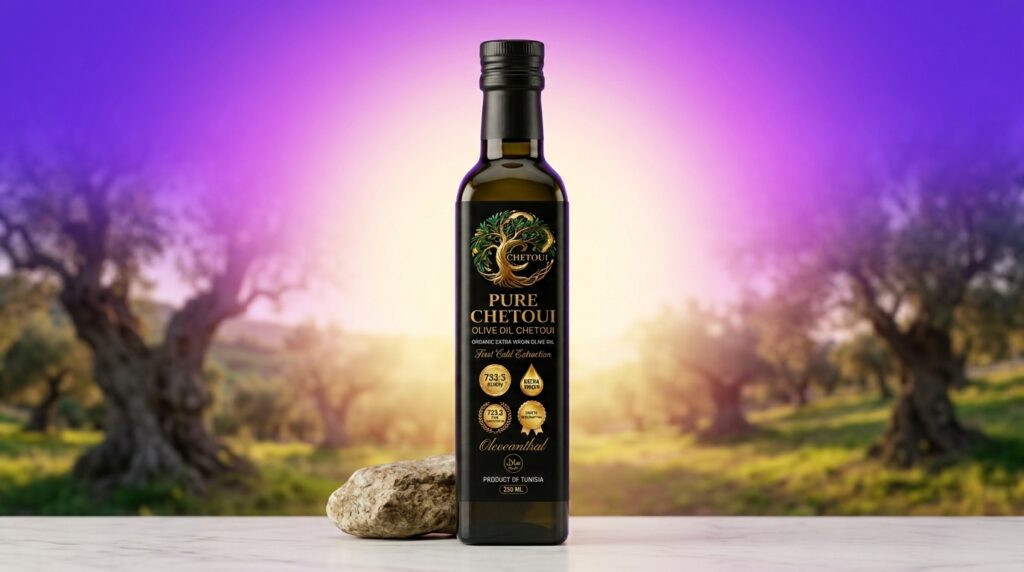

The name “Chetoui” comes from the Berber language, reflecting the cultivar’s pre-Arab, pre-Roman roots in North Africa. While Tunisia cultivates several olive varieties — including Chemlali in the south — the Chetoui cultivar dominates the northern highlands where conditions push the trees to produce their most potent fruit.
Tunisia: The World’s Quiet Olive Oil Powerhouse
When people think of olive oil, they think Italy, Spain, or Greece. But Tunisia is actually the world’s 4th largest olive oil producer and the largest producer in the Southern Mediterranean. According to the International Olive Council (IOC), Tunisia maintains over 80 million olive trees covering 1.7 million hectares — olive oil is central to its economy, culture, and identity.
Tunisia’s olive oil industry has a history spanning over 3,000 years, predating even Roman colonisation. The Romans expanded Tunisia’s olive groves massively, recognising the exceptional quality of North African olive oil. Archaeological sites across Tunisia — including the UNESCO World Heritage site of Dougga — still show ancient olive press ruins, testifying to millennia of unbroken olive oil production.
What makes Northern Tunisia the ideal terroir for premium Tunisian olive oil production:
- Climate stress — cold winters (temperatures dropping to 2 degrees Celsius) followed by hot, dry summers create natural stress that pushes polyphenol production to maximum levels
- Altitude — many Chetoui groves sit at 400 to 800 metres elevation in the Kroumirie and Mogod mountain ranges, where temperature swings are extreme
- Mineral-rich soil — the mountainous terrain provides well-drained, mineral-dense clay and limestone soil that concentrates flavour compounds in the fruit
- Low rainfall — water stress during the critical growing season further concentrates polyphenols, as the tree redirects its energy into defensive compounds
- Biodiversity — many Chetoui groves are surrounded by native Mediterranean forest, supporting pest-resistant ecosystems that reduce the need for chemical intervention
The result is a terroir-driven olive oil that cannot be replicated elsewhere — just as Champagne grapes can only produce true Champagne in the Champagne region of France, the Chetoui cultivar reaches its peak expression only in the specific microclimate of Northern Tunisia.
For decades, much of Tunisia’s olive oil production was exported in bulk to European bottlers who blended it with local oils and sold it under Italian or Spanish labels. This practice meant that many consumers were already drinking Tunisian olive oil without knowing it. The rise of single-origin transparency is finally giving the Chetoui cultivar the credit it has always deserved.
Chetoui Olive Oil Tunisia: 82 International Awards at NYIOOC
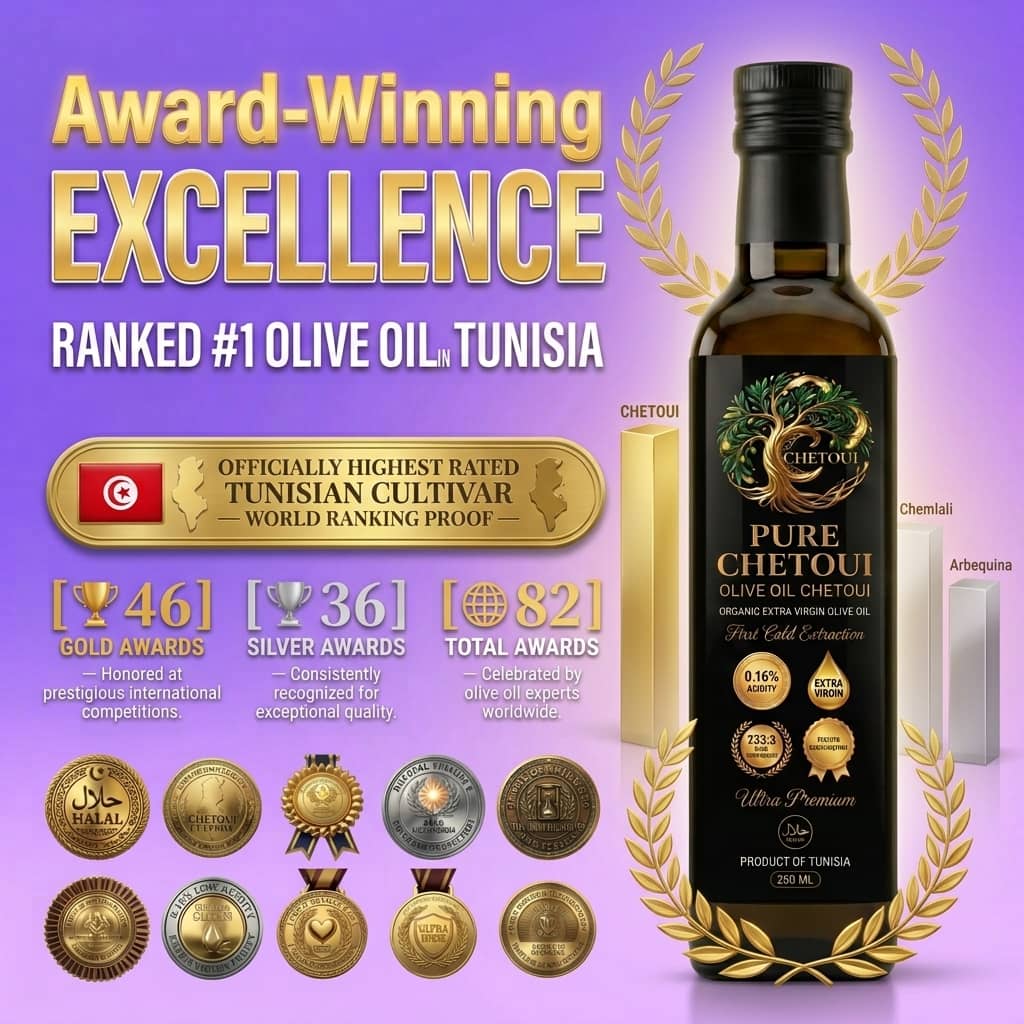
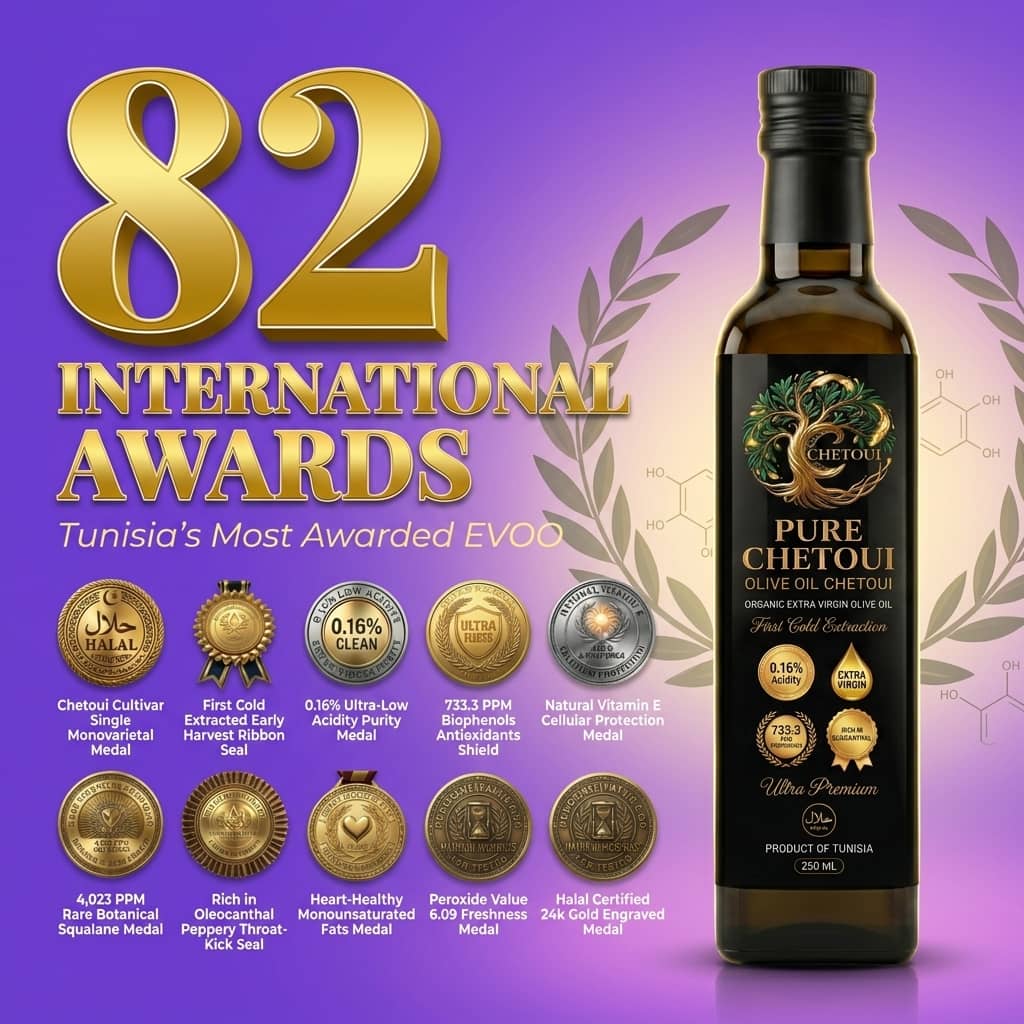
Chetoui olive oil Tunisia has earned an extraordinary 82 awards — 46 Gold and 36 Silver medals — at the NYIOOC World Olive Oil Competition, the world’s largest and most prestigious olive oil competition. This record makes Chetoui one of the most decorated single cultivars in international competition history.
To understand why this matters, consider what the NYIOOC represents:
- The NYIOOC receives entries from over 28 countries across five continents annually
- Only approximately 30 percent of entries win any award — the judging standards are among the strictest in the food world
- All entries are blind-tasted by a rotating panel of international experts who assess fruitiness, bitterness, pungency, harmony, and complexity
- The competition publishes its full results on bestoliveoils.org, making every result independently verifiable
The consistent Gold medal performance of Chetoui oils at the NYIOOC competition confirms something important: this cultivar is not merely analytically superior in laboratory measurements — it also delivers a flavour profile that the world’s top olive oil judges consistently rate as exceptional. The 46 Gold medals are particularly significant, as Gold at NYIOOC requires a higher threshold of quality than Silver.
These 82 awards validate what the chemical analysis already demonstrates: Chetoui olive oil Tunisia produces world-class quality that competes with and routinely surpasses the most celebrated European producers.
Why Chetoui Olive Oil Tunisia Produces the Highest Polyphenols
Polyphenol production in olives is fundamentally a defence mechanism. The olive tree produces polyphenols — including oleocanthal, hydroxytyrosol, oleuropein, and tyrosol — to protect its fruit from environmental threats such as UV radiation, pests, drought, and temperature extremes. The more the tree is challenged, the more polyphenols it produces.
Chetoui olive oil Tunisia achieves its record-setting polyphenol levels through a combination of four factors working in concert. Remove any single factor and the results diminish significantly:
- Genetic baseline — the Chetoui cultivar’s DNA codes for higher baseline polyphenol production than most other varieties. Research published by the IOC shows Chetoui naturally produces 2 to 3 times more polyphenols than mild cultivars like Arbequina, even under identical growing conditions
- Northern Tunisian environmental stress — the specific combination of altitude, temperature extremes, mineral-rich soil, and limited rainfall in Northern Tunisia maximises the tree’s polyphenol defence response beyond what genetics alone would produce
- Early harvest timing (November) — green olives harvested in early November contain peak polyphenol concentrations. Waiting until December or January for full ripeness increases oil yield but sacrifices 40 to 60 percent of polyphenol content. Early harvest is a deliberate quality choice that reduces quantity
- Cold extraction within 4 hours of harvest — polyphenols begin degrading the moment olives are picked. Processing within 4 hours using cold mechanical extraction (below 27 degrees Celsius) locks in the maximum polyphenol content. Many commercial operations wait 24 to 48 hours, losing significant potency
Pure Chetoui’s laboratory-verified 733.3 ppm biophenol count reflects the synergistic combination of all four factors. This level places it among the highest polyphenol concentrations ever documented in a commercially available extra virgin olive oil. For context, the EU health claim threshold for olive oil polyphenols is just 250 ppm — Pure Chetoui delivers nearly three times that benchmark.
Understanding high-polyphenol olive oil benefits is essential for appreciating why this concentration matters for human health.
Laboratory Analysis: 733 ppm Biophenols and Complete Chemical Profile
Every batch of Pure Chetoui Tunisian olive oil undergoes independent third-party laboratory testing. The current batch (early November 2025 harvest, Northern Tunisia) returned the following verified results:
| Parameter | Pure Chetoui Result | EVOO Standard | Significance |
|---|---|---|---|
| Biophenols (Total Polyphenols) | 733.3 ppm | EU health claim: >250 ppm | Nearly 3x the EU health claim threshold |
| Free Fatty Acidity (FFA) | 0.16% | EVOO max: 0.80% | 5x better than the EVOO maximum limit |
| Peroxide Value | 6.09 meq O2/kg | EVOO max: 20.0 | Indicates minimal oxidation and peak freshness |
| Oleic Acid | 65.24% | EVOO range: 55-83% | Heart-healthy monounsaturated fat content |
| Squalene | 4,023.80 mg/kg | Typical EVOO: 1,000-7,000 | Powerful antioxidant and skin-health compound |
| Alpha-Tocopherols (Vitamin E) | 446.6 mg/kg | Typical EVOO: 100-300 | Exceptionally high natural Vitamin E content |
| DAGs (1,2-Diacylglycerols) | 94.1% | Fresh EVOO: >85% | Confirms oil freshness and proper handling |
The acidity level of 0.16 percent is particularly noteworthy. Free fatty acidity is one of the most important markers of olive oil quality — it reflects how carefully the olives were handled between harvest and pressing. The EVOO maximum is 0.80 percent, and many “premium” oils sit between 0.30 and 0.50 percent. At 0.16 percent, Pure Chetoui demonstrates that the olives were processed in near-perfect condition.
The DAGs value of 94.1 percent is another critical freshness indicator. DAGs (diacylglycerols) gradually convert from the 1,2-position to the 1,3-position as oil ages. A value above 85 percent indicates genuinely fresh oil; Pure Chetoui’s 94.1 percent confirms the cold chain from Tunisia to your table is working as intended.
Chetoui vs Other Popular Olive Cultivars
How does the Chetoui cultivar compare to the olive varieties most consumers encounter? The differences are significant and measurable:
Chetoui vs Arbequina (Spain)
Arbequina is the world’s most widely planted olive variety — popular because it produces high yields and a mild, buttery oil that offends nobody. Typical polyphenol count: 100 to 250 ppm. Arbequina is the “commercial workhorse” of the olive oil industry — pleasant but unremarkable from a health perspective. The Chetoui cultivar is its polar opposite: lower yield, intense flavour, and polyphenol levels 3 to 5 times higher. If you are seeking high-polyphenol olive oil benefits, Arbequina simply cannot deliver what Chetoui provides.
Chetoui vs Koroneiki (Greece)
Koroneiki is Greece’s premium cultivar and the closest competitor to the Chetoui cultivar in polyphenol potential. Top Koroneiki oils from early harvest can reach 400 to 600 ppm — impressive by any standard, but still below what early-harvest Chetoui from Northern Tunisia consistently delivers at 700 ppm and above. Koroneiki has a more herbaceous, grassy profile; Chetoui leans toward robust bitterness with complex fruit notes and a more intense oleocanthal burn.
Chetoui vs Coratina (Italy)
Coratina is Southern Italy’s high-polyphenol variety, typically reaching 300 to 500 ppm from Puglia’s best producers. It shares Chetoui’s robust flavour character but generally does not match the polyphenol ceiling that Chetoui achieves in its optimal Tunisian terroir. Italian Coratina oils are genuinely excellent — and significantly more expensive due to Italy’s established branding premium and higher production costs.
Chetoui vs Picual (Spain)
Picual is Spain’s dominant variety, covering over 50 percent of Spanish olive groves. It is a solid all-rounder with 200 to 400 ppm polyphenols and good oxidative stability thanks to its high oleic acid content. However, Picual’s flavour profile (tomato-leaf, woody) is less complex than Chetoui’s multi-layered bitterness and signature peppery finish that lingers on the palate.
Polyphenol Comparison Summary
| Cultivar | Origin | Typical Polyphenols (ppm) | Flavour Profile |
|---|---|---|---|
| Chetoui | Northern Tunisia | 500-800+ | Robust, bitter, intensely peppery |
| Koroneiki | Greece | 400-600 | Herbaceous, grassy, medium bitter |
| Coratina | Southern Italy | 300-500 | Robust, bitter, artichoke notes |
| Picual | Spain | 200-400 | Tomato-leaf, woody, medium pungent |
| Arbequina | Spain | 100-250 | Mild, buttery, low bitterness |
The Flavour Profile of Chetoui Olive Oil
Chetoui olive oil from Tunisia is not for people who want a mild, background cooking oil. It is intensely flavourful — and that intensity is precisely what indicates its quality and polyphenol richness:
- Nose: Fresh-cut grass, green tomato, artichoke, with hints of green almond and wild herbs from the Tunisian hillsides
- Palate: Medium-to-intense fruitiness, pronounced bitterness (a positive attribute in premium oil that indicates oleuropein content), complex herbal notes with a green banana undertone
- Finish: Strong peppery kick at the back of the throat — the signature oleocanthal burn that signals high polyphenol content. Pure Chetoui’s distinctive “2-cough” peppery finish is immediately recognisable and a hallmark of genuinely potent olive oil
This flavour intensity is precisely what NYIOOC competition judges reward — and what distinguishes real premium Tunisian olive oil from the bland, deodorised, refined oils that dominate supermarket shelves worldwide. If your olive oil has no bitterness and no peppery burn, it has negligible polyphenol content regardless of what the label claims.
For Malaysian consumers, the robust character of the Chetoui cultivar pairs exceptionally well with local cuisine. It stands up to strong spices like turmeric, lemongrass, and chilli — where milder European oils would vanish into the background. Drizzled over nasi, mixed into sambal, or taken as a morning health spoon, the flavour commands attention.

Health Benefits of High-Polyphenol Chetoui Olive Oil
The extraordinary polyphenol concentration in Chetoui olive oil Tunisia translates directly into measurable health benefits. Research published in peer-reviewed journals has identified several mechanisms by which these compounds support human health:
Oleocanthal: Natural Anti-Inflammatory
Oleocanthal — the compound responsible for the peppery throat burn — has been shown in research to act as a natural anti-inflammatory with a mechanism similar to ibuprofen. The concentration of oleocanthal in high-polyphenol Chetoui oil is substantially higher than in standard olive oils, making it a meaningful dietary source of this compound. Learn more about oleocanthal’s anti-inflammatory properties.
Hydroxytyrosol: Powerful Antioxidant
Hydroxytyrosol is considered one of the most potent natural antioxidants ever studied. It protects LDL cholesterol from oxidative damage — the specific mechanism recognised by the European Food Safety Authority (EFSA) in their olive oil polyphenol health claim, which requires a minimum of 250 ppm total polyphenols consumed daily (5 mg hydroxytyrosol and derivatives).
Cardiovascular Protection
The combination of 733.3 ppm polyphenols and 65.24 percent oleic acid in Pure Chetoui provides a dual mechanism for heart health: the monounsaturated fats help maintain healthy cholesterol ratios while the polyphenols protect blood vessel lining from oxidative damage and inflammation.
Squalene and Vitamin E
Pure Chetoui’s squalene content (4,023.80 mg/kg) and alpha-tocopherol level (446.6 mg/kg) provide additional antioxidant protection. Squalene is increasingly studied for its role in skin health and cellular protection, while Vitamin E (alpha-tocopherol) is a well-established antioxidant that helps preserve both the oil itself and the cells of whoever consumes it.
How to Buy Authentic Chetoui Olive Oil Tunisia
As the Chetoui cultivar gains recognition, the risk of mislabelled or adulterated products increases. Here is how to verify that you are getting authentic Chetoui olive oil Tunisia and not a diluted imitation:
- Check the cultivar declaration — genuine Chetoui olive oil will state “Chetoui” or “100% Chetoui” on the label. If the label says only “Tunisian olive oil” without specifying the cultivar, it may be blended with the milder Chemlali variety
- Look for single-origin certification — “Product of Tunisia” should be clearly stated, with the specific region (Northern Tunisia, ideally naming the governorate) identified
- Demand lab results — any producer claiming premium quality should be able to provide batch-specific laboratory analysis showing polyphenol count, FFA, peroxide value, and fatty acid profile. If they cannot or will not share this data, look elsewhere
- Verify competition claims — NYIOOC results are publicly searchable on bestoliveoils.org. If a brand claims awards, verify them
- Taste it — authentic high-polyphenol Chetoui olive oil will have strong bitterness and a peppery throat burn. If it tastes mild and buttery, it is not what you are paying for
Understanding the difference between authentic and fake olive oil is critical, especially in Southeast Asian markets where adulteration is widespread. Minyak zaitun Tunisia from the Chetoui cultivar should always come with verifiable documentation.
How Pure Chetoui Brings This to Malaysia
Getting Chetoui olive oil Tunisia to Malaysia while preserving its quality requires specific handling at every stage of the supply chain:
- Single-origin sourcing — Pure Chetoui is not blended with oils from other regions, countries, or cultivars. It is 100 percent Chetoui from Northern Tunisia
- Cold-chain logistics — temperature-controlled shipping ensures polyphenols are preserved during the journey from Tunisia to Malaysia. Heat is the enemy of polyphenol preservation, and tropical transit temperatures can degrade oil quality if not managed
- Dark glass packaging — UV-protective dark bottles are essential for Malaysia’s bright tropical climate. Light exposure catalyses polyphenol degradation, which is why premium olive oil is never sold in clear glass bottles
- Batch-specific lab testing — every batch is tested independently at a certified laboratory, with full results published on the product page for anyone to review
- Halal certification — verified Halal certification documented for the Malaysian market
The result: 733.3 ppm polyphenols, 0.16 percent acidity, and a 6.09 peroxide value — delivered to your door at RM 109 per 250ml with free shipping across Malaysia.
For Malaysian consumers researching minyak zaitun Tunisia, Pure Chetoui represents the most scientifically documented and competition-verified option available in the local market. Every claim is backed by a lab report or a competition result you can independently verify.
Frequently Asked Questions About Chetoui Olive Oil Tunisia
Why haven’t I heard of Chetoui olive oil Tunisia before?
Tunisia’s olive oil has historically been sold in bulk to Italian and Spanish bottlers who rebrand it as their own product. An estimated 50 to 70 percent of Tunisia’s annual olive oil production was exported this way for decades. Direct-to-consumer single-origin Tunisian olive oil is a relatively recent development. As NYIOOC competition results bring transparency and consumer awareness grows, the Chetoui cultivar is finally gaining the international recognition its quality deserves.
Is Chetoui olive oil too strong for cooking?
Chetoui’s robust flavour is actually an advantage in cooking — it stands up to strong Malaysian spices and bold flavours where milder oils disappear entirely. The high polyphenol content also gives Chetoui olive oil superior thermal stability compared to low-polyphenol oils. For raw use (salad dressing, finishing drizzle, morning health spoon), the intensity is the point — that is where you taste and benefit from the polyphenols most directly. Start with a tablespoon and let the peppery kick speak for itself.
How does Chetoui compare to Italian olive oil?
Italy produces excellent olive oil, but much of what is labelled “Italian” is actually blended from multiple countries — including Tunisia. EU regulations allow this if bottling occurs in Italy. Single-origin Chetoui from Northern Tunisia consistently outperforms blended Italian oils in both polyphenol content and international competition results. The 82 NYIOOC awards — including 46 Gold medals — speak for themselves. Gram for gram and ringgit for ringgit, Chetoui olive oil Tunisia delivers more polyphenols per serving than the vast majority of Italian-labelled bottles.
Is Chetoui olive oil Halal?
Yes. Pure olive oil is naturally Halal — it is simply the juice of the olive fruit with no additives, processing aids, or animal-derived ingredients. Pure Chetoui is additionally Halal certified to meet the formal requirements of the Malaysian market, with certification verified and documented for full compliance.
What does 733 ppm polyphenols actually mean for my health?
The European Food Safety Authority (EFSA) approved a health claim for olive oil polyphenols at a minimum of 250 ppm, specifically for the protection of blood lipids from oxidative stress. At 733.3 ppm, Pure Chetoui delivers nearly three times this threshold in every serving. Research indicates that higher polyphenol intake is associated with greater anti-inflammatory and antioxidant activity. One to two tablespoons daily is the amount most commonly used in clinical studies examining olive oil polyphenol benefits.
How should I store Chetoui olive oil to preserve its polyphenols?
Store your Chetoui olive oil Tunisia in a cool, dark place away from direct sunlight and heat sources. In Malaysia’s tropical climate, this is especially important — avoid storing it near the stove, on a windowsill, or anywhere that gets direct afternoon sun. The dark glass bottle protects against UV light, but temperature matters too. Ideal storage temperature is between 15 and 25 degrees Celsius. Always reseal the bottle tightly after use to minimise air exposure. Once opened, consume within 3 to 4 months for optimal polyphenol potency — though the oil remains safe and pleasant to use well beyond this window.


Related posts
NYIOOC World Olive Oil Competition — The Ultimate Guide

NYIOOC olive oil competition results are the single most reliable indicator of olive oil quality in the world today.